What helps quickly during a panic attack?
A panic attack is a physical and psychological alarm reaction that occurs suddenly and usually only lasts a few minutes. The aim of immediate help is to end this state as quickly as possible. The following techniques can help you do this.
| Technique | How it works | Why does it help? |
| Conscious breathing: 4-7-8 breathing | Breathe in through the nose (4 sec.), hold your breath (7 sec.), exhale through your mouth (8 sec.). Repeat several times. |
The prolonged exhalation activates the parasympathetic nervous system and stops hyperventilation. |
| 5-4-3-2-1 grounding | Name 5 things that you can see, 4 that you can hear, 3 that you can touch, 2 that you can smell, 1 that you can taste. | Direct your attention away from the panic and anchor yourself in the present. The important thing here is not the order of the senses, but concentrating on the here and now. |
| Stay in the situation | Do not run away. Keep doing what you are doing - even if it is difficult. | Fleeing increases anxiety in the long term. Staying shows the brain that nothing bad is happening. |
| Use cold stimuli | Run cold water over your wrists, wet your face with cold water or place a cool pack on the back of your neck. | Stimulates the vagus nerve, lowers the heart rate and interrupts the anxiety spiral. |
| Get physically active | Shake out your arms, climb stairs, clench and unclench your fists, rotate your shoulders. | Releases the adrenaline and excess energy. |
| Self-soothing sentences | Say to yourself: "This will pass", "I am safe", "The fear is unpleasant, but not dangerous." | Break through anxiety-reinforcing thoughts and remind yourself that panic attacks are self-limiting. |
| Muscle tension | Clench your fists tightly for 5 seconds, then release. Work from the feet upwards through the body. | Releases physical tension and gives you something concrete and controllable. |
| Chew gum | Chew slowly and consciously. | Reduces jaw tension, stimulates saliva production and has a calming effect thanks to the rhythmic movement. |
| Call someone | Contact a trusted person and talk to them. | A human connection provides security, the voice of a familiar person is calming. |
Is it useful to breathe into a bag during a panic attack?
Another tip that is often given during a panic attack is to breathe into a bag. But does this actually help? Breathing into a bag can actually help during a panic attack, but it is not without risk.
The background: If you hyperventilate during a panic attack, you exhale too much CO₂, which makes your blood too alkaline. This can cause dizziness, tingling in the hands or chest pain. If you breathe into a bag, you absorb the CO₂ you exhaled, which can bring the pH value in your blood back into balance.
The problem: not every shortness of breath is a panic attack. A lack of oxygen - due to heart or lung problems, for example - can feel very similar. In such a situation, breathing into a bag would make the situation worse because additional oxygen is extracted.
In short, the method has a real biochemical benefit, but only if you are really sure that you are hyperventilating because of a panic attack. If in doubt, it is better to refrain from doing this and consciously breathe slowly instead.
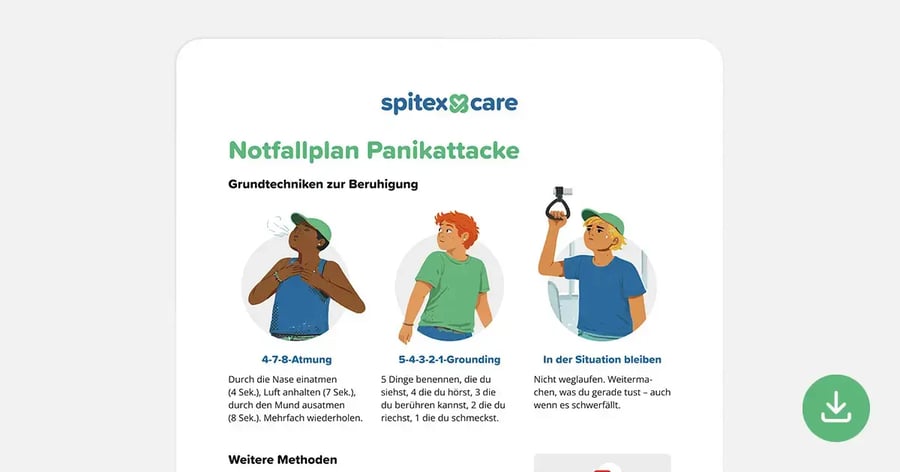
Your personal emergency plan for panic attacks
In this PDF, we summarize the most important techniques for immediate help. Keep it within easy reach or always have it with you.
How can Spitex help you with panic attacks?
Spitex organizations with professionally trained nursing staff with further training in psychiatric care, such as SpitexCare, can not only help those affected to overcome a panic attack in an acute case, but also support them in overcoming a panic disorder in the long term. Their work is divided into four phases:
Phase 1: Recognizing and assessing the acute panic attack
A psychiatrically trained nurse recognizes the typical signs of a panic attack through observation and trained perception and can differentiate these from emergencies such as heart attacks or asthma attacks. As some physical illnesses and medications can mimic symptoms of an anxiety disorder or panic attack, such symptoms should be clarified by a doctor at an early stage.
The nurse makes an important initial assessment: is it a panic attack or a somatic event that requires immediate medical intervention?
Phase 2: Acute intervention during the panic attack
The nurse is present, remains calm and provides targeted help in applying immediate aid techniques such as breathing exercises and grounding. Their empathic and understanding approach helps to reduce the feelings of shame that can arise during a panic attack. This is particularly important if the panic attack occurs on the move. SpitexCare therefore not only supports those affected at home, but also in everyday situations - especially those that already trigger the fear of a panic attack in those affected.
Phase 3: Follow-up and stabilization
The care professional conducts a structured follow-up discussion in which the experience is reflected on together: What happened? What did the person concerned feel? What helped, what didn't?
The course of the attack is documented - duration, intensity, triggering factors, interventions used and their effectiveness. This information flows into the therapeutic treatment, for example in the work with psychotherapists. A personal crisis plan is drawn up together with the person concerned: What are the early warning signs? Which techniques work best for this person? Who can they talk to? Crisis intervention also includes action planning - developing initial steps for coping - as well as resource work, i.e. activating social networks and personal strengths.
Phase 4: Long-term support and prevention
As part of psychoeducation, care professionals provide those affected with knowledge about their illness, explain the panic vicious circle and avoidance behavior, for example, and give tips on relapse prevention. They also lead therapeutic exercises, for example on relaxation, mindfulness or progressive muscle relaxation.
When working with relatives, they mediate between those affected, relatives and the care team and train relatives on how to deal with panic attacks - for example, how to remain calm and convey a sense of security.
In outpatient psychiatric care, they support people with mental illnesses and their relatives at home, with the aim of promoting health, overcoming crises and achieving stability.
You are not at the mercy of panic
A panic attack feels like the ground is falling out from under your feet - your heart races, your breath becomes tight and for a moment everything seems out of control. But as overwhelming as this experience is, every panic attack passes. It is not dangerous, even if it feels like it is. And above all, you don't have to go through it alone.
With a clear emergency plan - breathing techniques that you have practiced, grounding exercises that bring you back into the moment and the knowledge of what is happening in your body - you have tools in your hand that really help. If you also have reliable support, be it from psychiatrically trained care professionals such as SpitexCare or from relatives who know how to be there for you in such moments, then you are prepared. Not perfect, not without fear, but prepared. And that makes all the difference.
Have the courage to accept support. Talk to your doctor, your therapist or contact SpitexCare directly as a specialized Spitex service. Every step you take, even the smallest one, is a step back towards more security and self-determination in your life.